
Air curtains
Windis designs and manufactures air curtains in Veteli, Finland. The range has three mounting types, two power classes and five widths. All share one controller, and on water-heated models energy metering is part of the standard equipment.
Size it in Windis Select- Mounting types: Free, Ceil, Vertical
- 3
- Power classes
- 350 / 500
- Widths, five options
- 1–3 m
- Installation height, 350 / 500
- 3.5 / 5 m
What an air curtain is and what it does
An air curtain is mounted above or beside a doorway and blows a controlled air jet across the opening. The jet separates indoor and outdoor air while the door is open.
When the door opens, warm indoor air flows out and cold outdoor air flows in on the temperature difference alone. An air curtain reduces that flow, so draught around the entrance decreases and less heat escapes through the door.
How much an air curtain reduces energy loss
An air curtain that is correctly sized, installed and controlled significantly reduces the energy loss through an open doorway. Eurovent describes the effect as climate separation effectiveness (CSE), which states how much of the doorway's energy loss is avoided thanks to the air curtain. In Eurovent's design table, an air curtain that is properly specified and either verified in use or automatically controlled has a CSE of roughly 0.6 to 0.8. That corresponds to a reduction of roughly 60 to 80 per cent in the energy loss through the doorway, compared with the same doorway without an air curtain.
Source: Eurovent 16/5 - 2025, Air Curtain Units – Technical Overview, section 1.2, table 2. The value is Eurovent's general design guidance for air curtains, not a measured value for a Windis product, and it concerns the energy loss through the doorway, not a building's total consumption.
Where air curtains are used
- Entrances to retail premises and shops
- Offices, schools and daycare centres
- Hotel lobbies and representative spaces
- Overhead doors in industry and logistics
- Cold stores and refrigerated spaces
Completed projects: References
Water-heated, electrically heated or ambient
The heating type is chosen as part of the unit's equipment: the same Free, Ceil or Vertical is available in all three.
Water-heated air curtain
When the building has a water-based heating system.
The most common choice. Water-heated Windis air curtains carry integrated energy metering and automatic diagnostics as standard, so the thermal energy the unit consumes appears in the building management system as a measured figure.
Electrically heated air curtain
When there is no water circuit, or installation has to be quick.
Four-stage electric heating, fixed connection 400 V 3N~. The same controller and the same building management interface as the water-heated units. Energy metering is a feature of the water-heated models and is not included in the electrically heated ones.
Air curtain without heating
When the purpose is to separate two temperature zones.
For cold stores, freezer rooms and refrigerated spaces, where the job of the air jet is to separate the zones rather than to heat the entrance.
Free, Ceil or Vertical
The mounting type follows from the doorway and the structures around it. All three share the same controller, the same interfaces and the same widths.
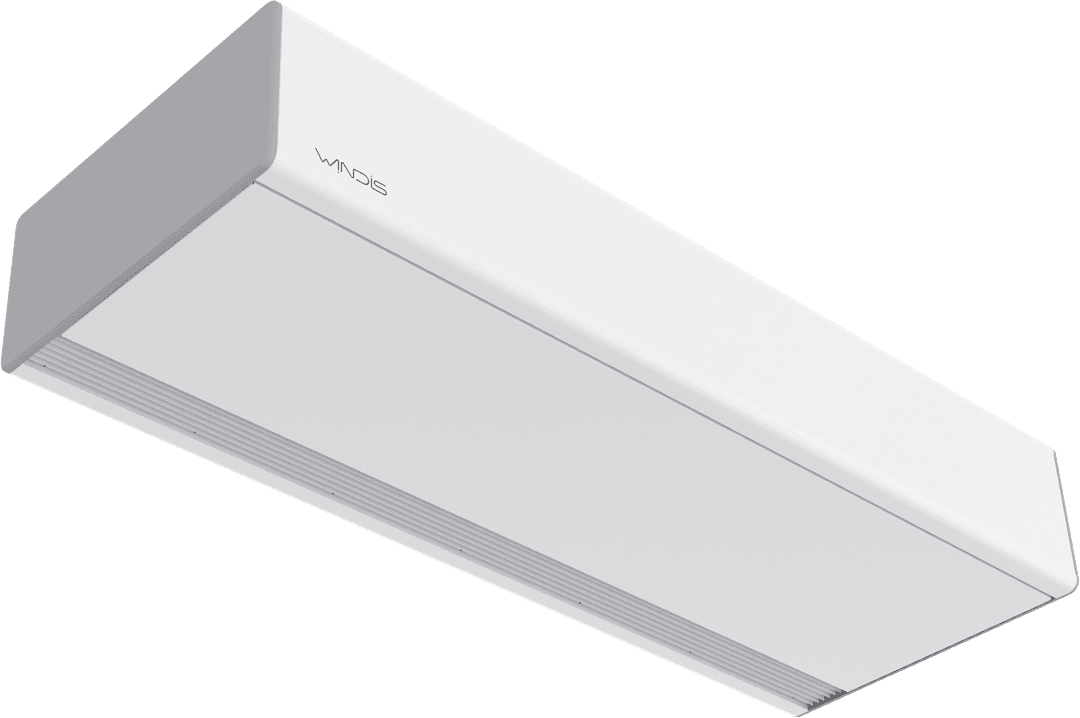
Windis Free
Surface-mounted above the doorway. Suits spaces with no suspended ceiling, or where the unit may be visible.
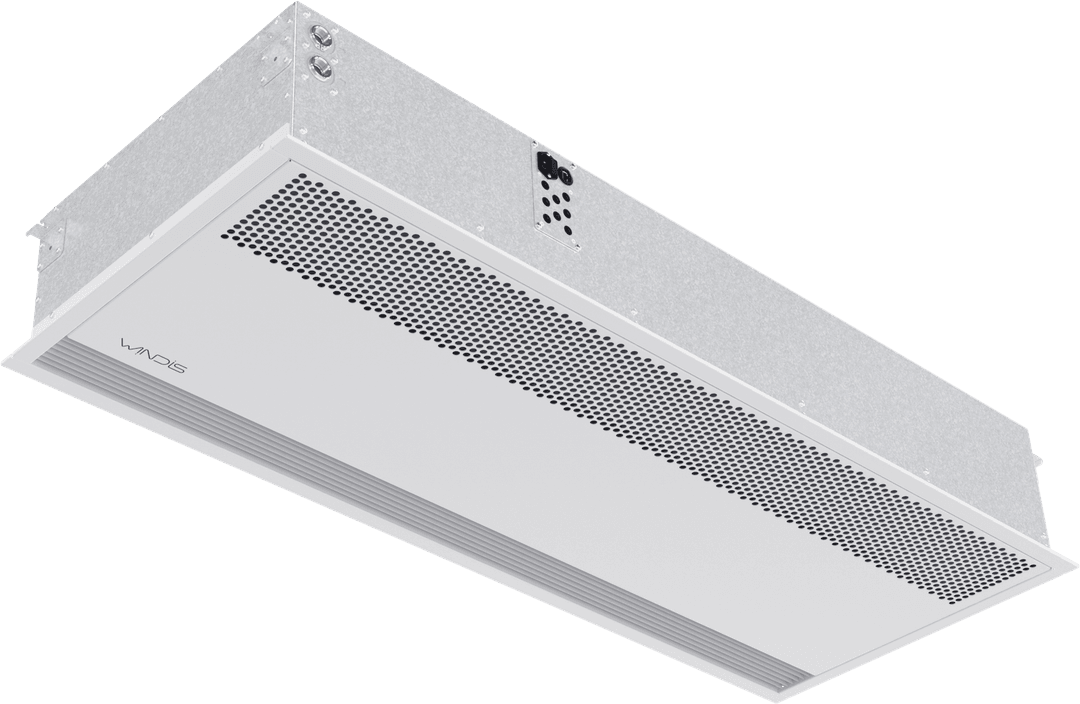
Windis Ceil
Recessed into the suspended ceiling, leaving only the grille in view. Suits entrances that have to stay clean-lined.
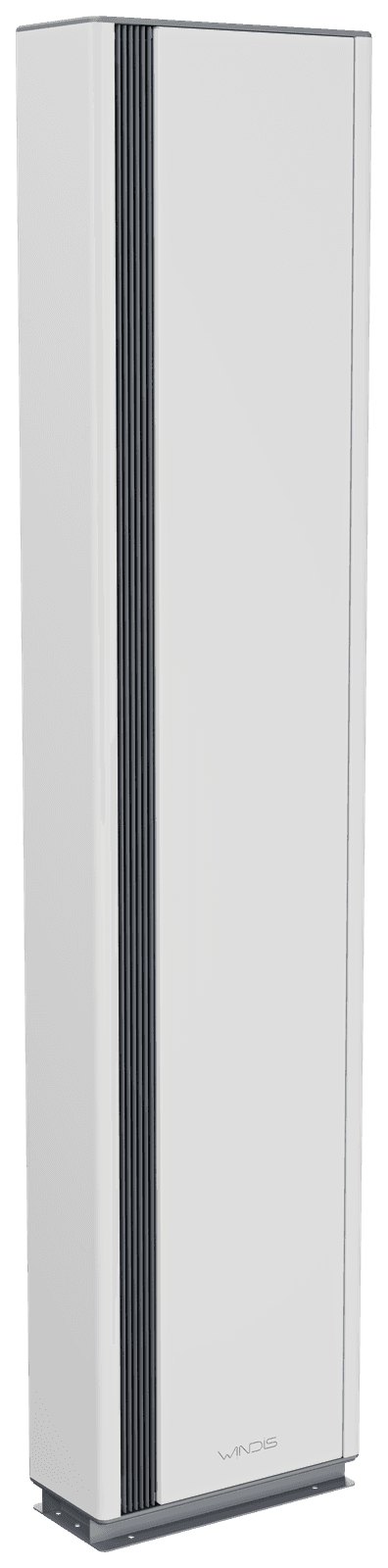
Windis Vertical
Mounted vertically at the side of the door, when horizontal mounting is not possible. The recommended doorway width is up to 5 metres with units on both sides of the door, and units can be stacked to cover taller openings.
Choosing a model by application
Scroll the table sideways
| Application | Recommended model | Why |
|---|---|---|
| Retail premises or shop | Windis Free 350 | Ordinary traffic, spaces with no suspended ceiling |
| Office, school or daycare centre | Windis Ceil 350 | Recessed into the ceiling, only the grille shows |
| Hotel or representative space | Windis Ceil 350 | The entrance stays clean-lined |
| Industry or logistics | Windis Free 500 | Tall doorway and busy traffic, surface mounting |
| Hall or logistics building with a suspended ceiling | Windis Ceil 500 | The same power class recessed into the ceiling |
| Narrow door or side mounting | Windis Vertical 350 | Vertical mounting on both sides of the door |
| Tall industrial door | Windis Vertical 500 | Vertical mounting, units can be stacked |
| Cold store or freezer room | Windis Free 350 | Separating air jet without heating. Free 500 for large openings. |
The range is Free 350 and Free 500, Ceil 350 and Ceil 500, and Vertical 350 and Vertical 500. Each has its own product page, and site-specific sizing is done in Windis Select.
350 and 500 series, widths and installation height
- 350 series
- Installation height up to 3.5 metres. Ordinary traffic: retail premises, offices, schools and daycare centres.
- 500 series
- Installation height up to 5 metres. Busy traffic or a tall doorway: industry, logistics and shopping centres.
- Widths
- 1 m, 1.5 m, 2 m, 2.5 m and 3 m in every series. Wide doorways take two units side by side.
Performance ranges per series and per-model data are on the product pages.
What sizing is based on
The size of an air curtain does not follow from the width of the door alone. At least these affect the sizing:
- Width and height of the doorway
- Indoor and outdoor temperature, and the space's base heating load
- Installation height and mounting type
- Required airflow and discharge impulse
- Heating demand and heating type
- How the door is used: how often and how long it stands open
- Vestibule, building pressure conditions and prevailing wind
The starting points for the calculation, the formula and a worked example at a design condition are covered in a separate guide.
Read: How to size an air curtain correctlySite-specific sizing is done in Windis Select. It calculates the performance values for the chosen unit and produces the sizing report, the functional description, the schematic and the MagiCAD codes for the design documents. Choosing the product remains with the designer.
Technical platform and building management
Every Windis air curtain has the same controller and the same interfaces, with no add-on modules or separate licences.
Integrated energy metering
Standard on water-heated models: the heat energy each unit uses is metered at the unit.
Automatic diagnostics
A combination of measurement points identifies fault conditions directly at the unit. Status data is read from the same registers as the measurement data.
Interfaces as standard
Modbus TCP, BACnet IP, Modbus RTU / BACnet MSTP and I/O.
Commissioning in a browser
M12 quick connectors for external sensors, plus Ethernet and USB. The service hatch does not have to be opened during installation.
Brochures, installation instructions and Modbus registers: Documents
Frequently asked questions
How does an air curtain work?
An air curtain blows an air jet across the doorway. The jet separates indoor and outdoor air, so the inflow of cold air and the heat escaping through the door both decrease. The jet has to reach the full height of the doorway for the separation to work.
When should a water-heated air curtain be chosen?
When the building has a water-based heating system. It is the most common choice, and water-heated Windis models carry integrated energy metering as standard, so the thermal energy the unit consumes can be verified by measurement.
How high can an air curtain be installed?
The 350 series has an installation height of up to 3.5 metres and the 500 series up to 5 metres. With Vertical models, units can be stacked to cover taller doorways.
Does the air curtain have to be as wide as the door?
The air jet has to cover the full width of the doorway for the separation to work across the whole opening. Wide doorways take two units side by side. The widths are 1 m, 1.5 m, 2 m, 2.5 m and 3 m.
How is an air curtain sized?
Sizing starts from calculating the heat loss of the doorway, and it is affected by the dimensions of the opening, the indoor and outdoor conditions, how the door is used and the conditions at the door. The calculation and a worked example are in the sizing guide, and site-specific sizing is done in Windis Select.
What is the difference between the Free, Ceil and Vertical models?
The difference is the mounting type. Free is surface-mounted above the doorway, Ceil is recessed into the suspended ceiling and Vertical is mounted vertically at the side of the door. The controller, the interfaces and the widths are the same.
What is the difference between the 350 and 500 series?
Power class and installation height. The 350 series is intended for installation heights up to 3.5 metres and the 500 series up to 5 metres. The 500 series suits busy traffic and tall doorways.
Can an air curtain be connected to a building management system?
Yes. Modbus TCP, BACnet IP, Modbus RTU / BACnet MSTP and I/O are standard on every model, with no add-on modules and no licences. The building management system sets the run permissions and setpoints, and reads measurement and status data from the controller.
Can an air curtain be used without heating?
Yes. An ambient, unheated model suits cold stores, freezer rooms and refrigerated spaces, where the job of the air jet is to separate the temperature zones.
Size your project in Windis Select
Enter the door dimensions, the conditions and the heating type, and Select calculates the performance values and produces the documents for the design. Help with choosing the size class is available directly from Windis.